
TermScout Introduces Portfolio in Procurement View to Reveal Contract Patterns Across Supplier Agreements
New Portfolio surface helps procurement teams identify recurring contract positions, friction, and issues requiring
Press Release Disclaimer: This is a press release distributed through the XPR Media network. It has not been independently verified by our newsroom.
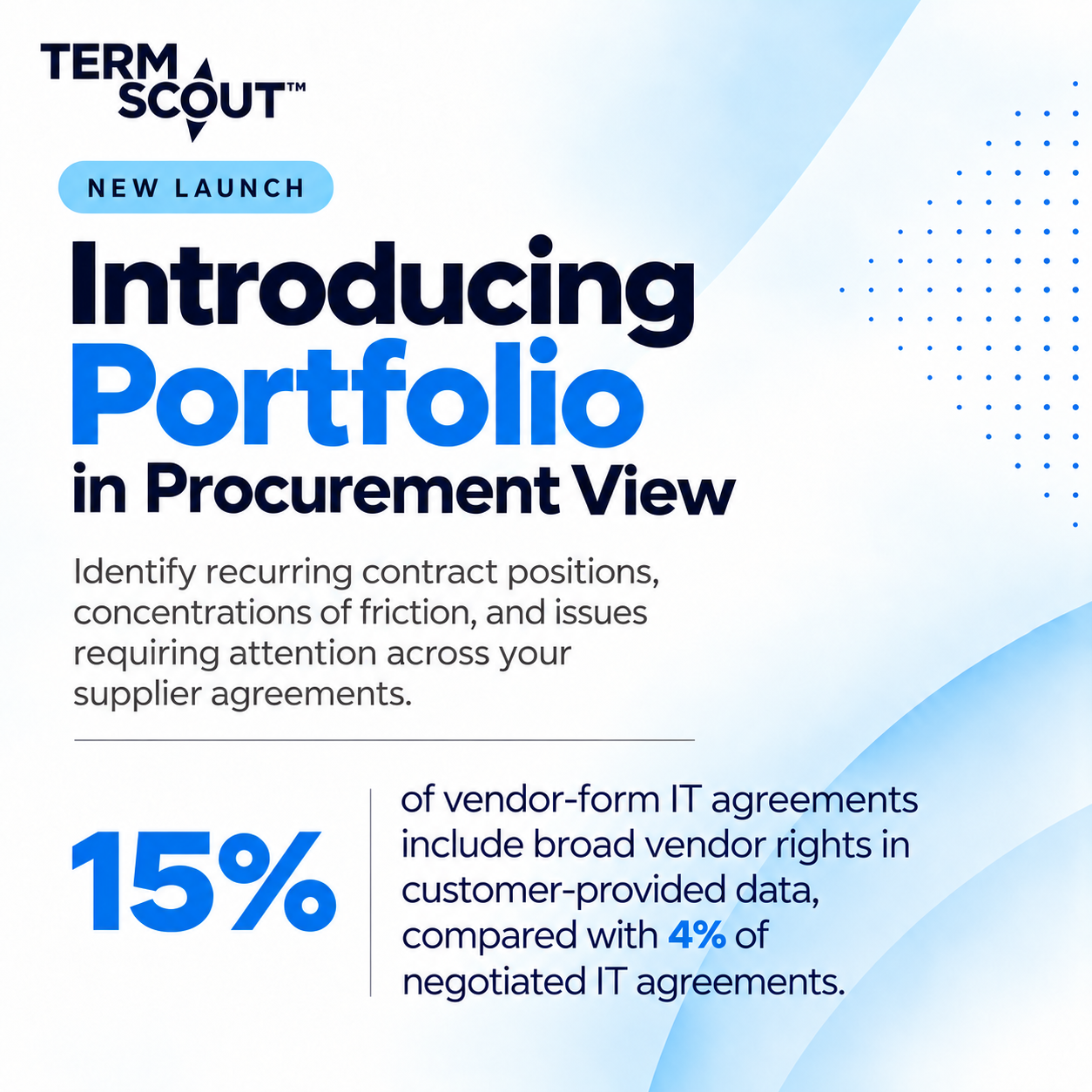

New Portfolio surface helps procurement teams identify recurring contract positions, friction, and issues requiring attention across their supplier agreements.
SAN FRANCISCO, CA, UNITED STATES, September 22, 2026 /EINPresswire.com/ — TermScout today introduced Portfolio, a new surface within Procurement View that helps procurement teams understand contract positions and negotiation patterns across their supplier agreements.
Procurement teams routinely negotiate protections, accept exceptions, and resolve individual contract issues. Over time, those decisions accumulate across hundreds or thousands of agreements. Without a portfolio-level view, teams may know what happened in a particular contract while lacking visibility into where the same position, exception, or source of friction appears repeatedly across the organization.
Portfolio organizes contract intelligence across selected agreements so procurement leaders can identify recurring patterns, investigate concentrations of potential exposure, and focus attention on the issues with the greatest organizational significance.
“Every negotiated agreement becomes part of a much larger supplier portfolio,” said Olga V. Mack, CEO of TermScout. “Procurement leaders need to understand more than what happened in one contract. They need to see where positions are repeating, where friction is concentrated, and which patterns should influence renewals, sourcing decisions, and contracting standards.”
Portfolio Turns Agreements into Procurement Intelligence
The Portfolio surface of Procurement View gives procurement teams an analytics-led view across selected supplier agreements.
Teams can use Portfolio to:
• Identify agreements that lack protections the organization expects.
• Find potentially unfavorable positions that recur across suppliers.
• See where negotiation friction is concentrated.
• Investigate patterns affecting upcoming renewals or sourcing decisions.
• Compare internal contract positions with company standards and external market evidence.
• Identify the agreements contributing to a portfolio-level finding.
• Inform contracting standards, negotiation priorities, and supplier strategy.
Portfolio also helps teams distinguish an isolated contract issue from a recurring pattern that may require broader attention. Procurement leaders can move from asking, “What happened in this agreement?” to asking, “Where is this happening across our agreements, and what should we do about it?”
Why Portfolio-Level Visibility Matters
TermScout’s external contract data illustrates why agreement-level visibility alone is insufficient.
Broad vendor rights to use customer-provided data appear in 15% of vendor-form IT agreements and 4% of negotiated IT agreements in the analyzed populations. For a procurement team, the practical question is not limited to whether this position appears in a single contract. The larger question is where it appears across the organization’s supplier agreements and whether it reflects an isolated exception or a recurring pattern.
Portfolio is designed to help procurement teams answer that question using their own agreements.
Portfolio Within Procurement View
Portfolio is one of four connected surfaces within TermScout’s Procurement View:
• Deals supports active contract evaluation and negotiation” to match the surface name.
• Agreements supports ongoing agreement management and renewal preparation
• Portfolio reveals patterns across an organization’s selected agreements
• Market provides external evidence from real-world contracts
Together, these surfaces help procurement teams make more informed decisions across active negotiations, existing agreements, internal portfolio patterns, and external market context.
Data Note
The customer-data-rights finding is based on 2,436 vendor-form IT agreements, 52 customer-form IT agreements, and 242 negotiated IT agreements. The relevant provision was present in 364 vendor forms, five customer forms, and 10 negotiated agreements.
The analysis compares the prevalence of the provision across the stated contract populations. It does not establish a change over time or prove that negotiation caused the observed differences. Percentages are rounded to whole percentages and reflect TermScout’s classifications of the stated contract populations.
About TermScout
TermScout is the contract intelligence layer for legal, procurement, and sales teams. Its platform helps organizations understand agreements, compare contract positions, identify portfolio-level patterns, and evaluate those positions using evidence from real-world contracts.
TermScout’s Procurement View connects intelligence across active deals, existing agreements, internal contract portfolios, and the broader market so teams can make faster, more consistent contracting decisions.
For more information, visit www.TermScout.com
Renee Donis
TermScout
+1 612-599-3419
email us here
Visit us on social media:
LinkedIn
YouTube
Legal Disclaimer:
EIN Presswire provides this news content “as is” without warranty of any kind. We do not accept any responsibility or liability
for the accuracy, content, images, videos, licenses, completeness, legality, or reliability of the information contained in this
article. If you have any complaints or copyright issues related to this article, kindly contact the author above.

Media gallery


